Every aspiring architect starts their journey with a burning desire to be creative and design spaces that nurture people, stories, and emotions. They envision a future where, after years of rigorous study and internships, they’ll finally be able to unleash their creativity and make a significant impact on the world of tomorrow.
However, reality often paints a different picture. Instead of diving into the creative process, young architects find themselves overwhelmed by complicated software, an array of tools, and features that seem endless. Even the smallest changes necessitate a deep dive into the “building materials” book. This intricate process consumes time, and for SMBs and freelancers, this time is often poorly compensated. The stress and complexity of these tasks stifle creativity and take a toll on professional well-being.
At Synaps, we started questioning this complexity and decided to research existing tools like AutoCAD, Revit, and Archicad.
Our initial step was to inventory the features these tools offer. We analyzed their use cases and categorized them based on their functions. It became clear that the gap between 2D and 3D modeling (CAD & BIM) was significant, and both large and small projects suffered from different types of complexity.
BIM and Its Current Use
In the realm of 3D modeling (incl. BIM), the third dimension introduces a substantial layer of complexity. Designing elements such as walls, windows, doors, stairs, columns, or beams requires users to input numerous parameters. The more parameters needed, the longer it takes to complete the task. While these details are crucial for large, unique projects, they add unnecessary complexity to regular structures, which make up 91% of our built environment (Fig.01). This not only extends drawing time for architects but also increases the risk of miscommunication between contractors who are not BIM specialists and cannot extract information from a digital model. Consequently, architects often revert to 2D CAD software like AutoCAD.
CAD and Its Drawbacks
AutoCAD, a revolutionary drafting tool introduced in the early 80s, relies on basic primitive editing tools that can be manipulated into virtually anything. It is used by architects and professionals in machinery production, medical production, product design, naval architecture, and more. However, as a horizontal tool, it must accommodate many use cases, which brings downsides for architectural design. Architects end up designing with lines rather than walls, requiring multiple manipulations to achieve the same visual representation. This results in a more time-consuming workflow with static outputs that cannot be easily replicated or used in multiple projects.
Our team conducted a study, gathering all the features and tools from existing software and compiling a list of 1,200 different entities. We involved 30 architects, asking them to choose the tools they needed and used most frequently. The result was epiphanic: out of the 1,200 tools, only 56 were chosen.
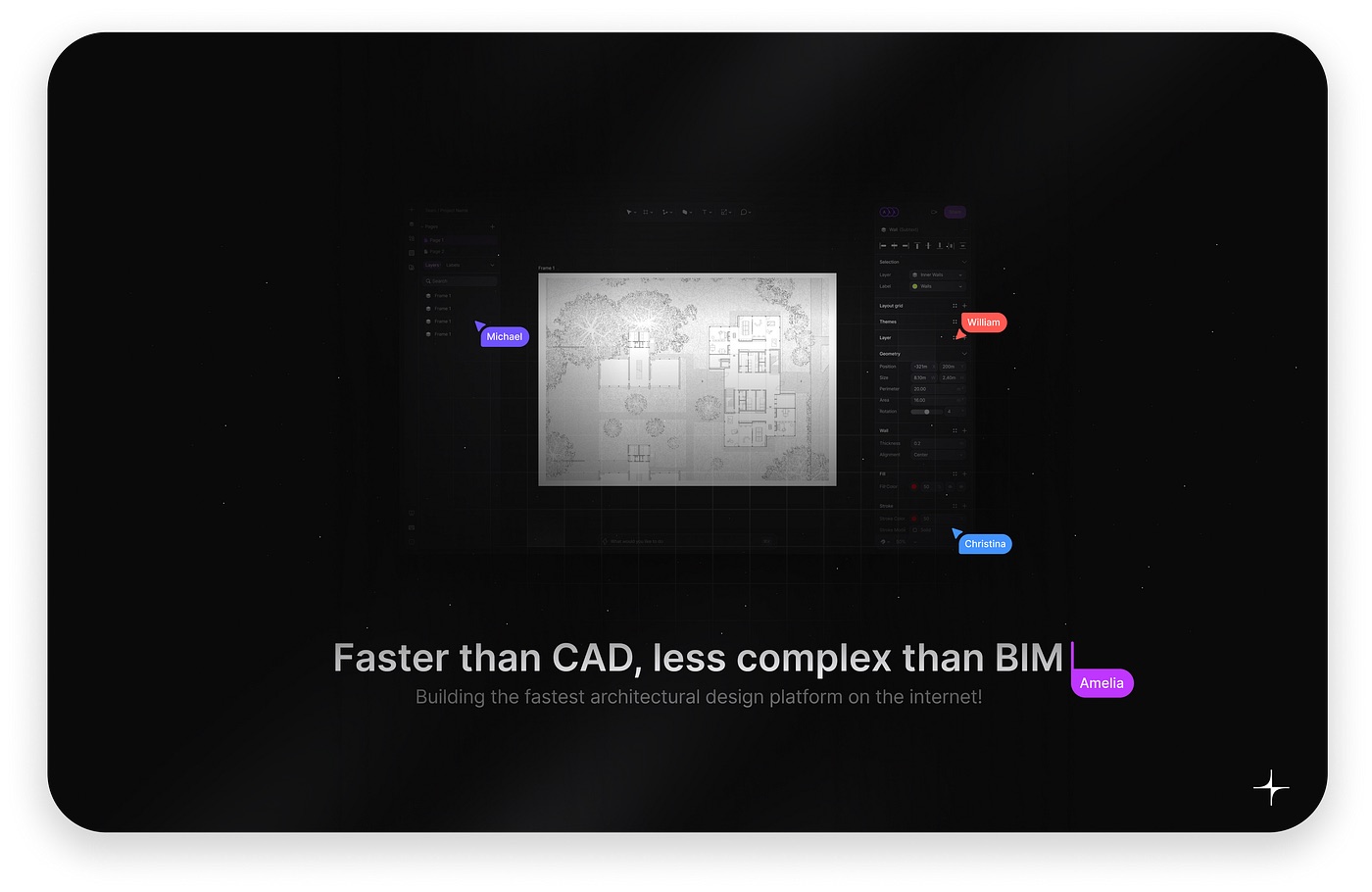
With this in mind, Synaps was created to offer a new toolset that allows architects to design architectural drawings with minimal input and an intuitive, simplified user experience. We integrated BIM tools such as predefined walls, windows, doors, columns, beams, and stairs into the 2D CAD workflow. The third dimension is considered only from a visual perspective, reducing parametrization and allowing for faster draft creation tailored to 91% of the built environment. Synaps serves as a bridge between CAD and BIM, faster than CAD and less complex than BIM.
Join the waitlist today and be among the first to experience the fastest and most intuitive architectural design platform on the internet!